
1. Technical Whitepaper: CE Certified Modern Double Entry Doors Manufacturing Standards
In high-end architectural design, modern residential construction, and commercial developments, the main double entrance door serves as both the visual center of the façade and the primary barrier against environmental elements and forced entry. Global buyers—including architectural specifiers, general contractors, fenestration distributors, and commercial developers—face increasing pressure to procure entrance systems that balance sophisticated aesthetics with rigorous mechanical durability and thermal compliance.
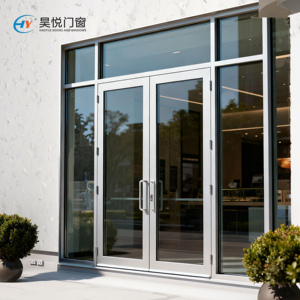
Achieving compliance with European Norm CE Standard EN 14351-1 requires comprehensive structural testing. A CE-certified modern double entry door system is evaluated not merely as raw aluminum profiles or glass panels, but as a fully integrated factory assembly encompassing frame extrusions, polyamide thermal barriers, multi-point lock mechanisms, perimeter EPDM weather seals, and structural insulated glass units (IGUs).
Crestor Door Manufacturing Co., Ltd., established in 1997, operates a state-of-the-art 100,000 m² smart manufacturing base in Dongying, Shandong, backed by a dedicated R&D center in Beijing. With over 200 engineers, technicians, and specialized craftsmen, Crestor engineers entrance solutions that exceed basic international building code standards. By integrating laser cold-welding corner construction with high-grade PA66 nylon thermal break strips, Crestor modern double entry doors achieve structural wind pressure resistance up to 5.0 kPa (GB/T 31433 Grade 9 / Top Class) and acoustic attenuation ratings reaching Rw 44 dB.
2. Engineering Rigor & Crestor Manufacturing Supremacy
To eliminate callbacks, seal degradations, and alignment failures typical of lower-tier manufacturers, Crestor maintains absolute end-to-end control over four foundational processes: aluminum profile CNC machining, surface treatment powder coating/PVDF, insulating glass processing, and final automated unit assembly. This single-point-of-accountability model ensures every set of double entry doors strictly adheres to targeted engineering tolerances.
±0.05 mm CNC Milling Tolerance
Every profile corner, lock pocket, and hinge mortise is executed using 5-axis CNC equipment. Precise machining guarantees air-tight joint fitment and smooth hardware actuation across thousands of operating cycles.
Laser Cold-Welding Technology
Unlike conventional mechanical crimping or simple sealant corner connection, Crestor utilizes patented laser cold-welding corner joints (Patent count 219+). This structural technique creates a seamless, monolithic frame corner immune to seasonal expansion stress.
PA66 Technoform Thermal Barriers
Extruded aluminum alloy (6063-T6) is structurally separated by imported Technoform PA66 polyamide thermal break strips reinforced with 25% fiberglass, reducing frame thermal bridging to achieve system U-values as low as 0.9 W/m²K.
Triple-Seal EPDM Weather Stripping
Utilizing continuous, vulcanized EPDM gaskets arranged in a 3-tier barrier system, Crestor double entry doors prevent water infiltration even when subjected to wind-driven rain tests up to 700 Pa (Class E1050 / Grade 6).
In-House Architectural Glazing
Double and triple-glazed Low-E units filled with 90%+ pure argon gas are fabricated within Crestor's cleanroom glass processing division, ensuring warm-edge spacer longevity and anti-fog performance guarantees.
AkzoNobel Fluorocarbon & PVDF Coatings
Surface finishing complies with Qualicoat Class 2 standards. Fluorocarbon and powder-coat finishes resist intense UV exposure, coastal salt-spray oxidation, and mechanical abrasion without chalking or peeling.
3. Verified CE Standard Performance Data & Engineering Metrics
To assist building physics engineers, facade consultants, and procurement managers in verifying specification compliance, the following matrix outlines the verified performance metrics of Crestor CE-certified modern double entry door systems compared against European (EN) standards.
| Performance Characteristic | Test Standard | Tested Value / Class | Architectural Application Advantage |
|---|---|---|---|
| Wind Pressure Resistance | EN 12210 / GB/T 31433 | 5.0 kPa (Class C5 / Grade 9) | Ensures frame deflection compliance on exposed coastal villas and high-rise commercial entryways. |
| Water Tightness | EN 12208 | 700 Pa (Class E1050 / Grade 6) | Prevents water ingress during severe hurricane-force weather events and heavy wind-driven rain. |
| Air Permeability | EN 12207 | Class 4 / Grade 8 (Highest) | Eliminates uncontrolled air infiltration, substantially lowering building HVAC load requirements. |
| Thermal Transmittance (U-Value) | EN ISO 10077-2 | Ud ≤ 0.9 W/m²K | Supports Passive House envelope design goals when integrated with triple Low-E insulated glass. |
| Acoustic Insulation | EN ISO 717-1 | Rw 44 dB (-1; -4) | Dampens ambient urban traffic noise and airport proximity sound, protecting interior acoustic comfort. |
| Burglar Resistance / Security | EN 1627 | RC2 / RC3 Rating | Multi-point steel locking hooks and anti-drill cylinder plates prevent mechanical forced entry tools. |
4. Future Procurement Trends & Architectural Product Trajectories
As the international architectural and building materials landscape evolves toward net-zero carbon targets and smart building automation, bulk buyers must align their supply chains with manufacturers capable of delivering next-generation entrance technology.
A. Smart IoT Integration & Concealed Motorized Multi-Point Locking
Modern commercial and luxury residential properties are rapidly abandoning traditional mechanical keyways in favor of integrated smart access controls. Sourcing trends indicate a massive shift toward CE-certified entry doors pre-wired for biometric fingerprint scanners, facial recognition cameras, RFID card sensors, and home automation systems (Zigbee/Matter/KNX). Crestor integrates fully concealed electromechanical multi-point locks that automatically engage multiple steel deadbolts upon door closure while maintaining a clean, hardware-minimalist outer profile.
B. Oversized Double Leaf Geometries & Pivot Systems
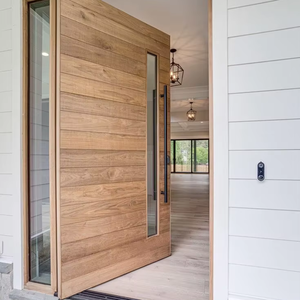
Architectural demand for soaring, grand entryway heights (spanning 3.0 to 4.5 meters in height and up to 2.4 meters in double-leaf width) requires elevated structural section moduli. Traditional aluminum extrusions deflect under structural self-weight and wind forces. Modern manufacturing relies on heavy-wall 6063-T6 aluminum alloys combined with internal steel reinforcement sleeves and heavy-duty concealed German pivot hardware capable of supporting single-leaf weights exceeding 400 kg effortlessly.
C. Carbon Footprint Compliance & Circular Aluminum (CBAM Alignment)
With the implementation of the European Union's Carbon Border Adjustment Mechanism (CBAM) and global ESG procurement mandates, commercial developers require verified environmental product declarations (EPDs). Aluminum entrance doors produced with low-carbon primary aluminum billets, zero-VOC powder coatings, and recyclable PA66 thermal strips present a distinct competitive advantage in international public tenders and green building certifications (LEED v4, BREEAM).
D. Thermal Break Modern French & Double Casement Doors
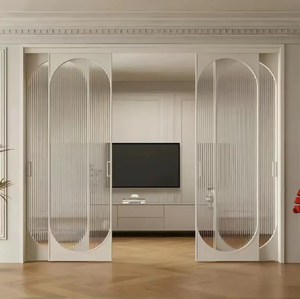
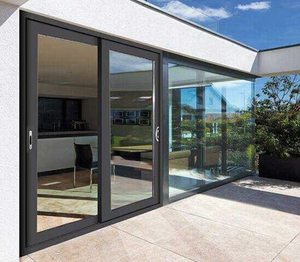
The distinction between exterior security entry doors and patio/terrace entrance double doors continues to blur. Modern architectural trends emphasize full-vision double glass French doors equipped with thermal break frames, ultra-narrow sightlines (down to 55mm visible width), and flush drop-down bottom weather seals. These systems provide uninterrupted panoramic views while meeting strict climate zone insulation guidelines.
5. OEM & ODM Strategic Procurement Workflow for Global Distributors
Sourcing high-end fenestration products from overseas factories requires a structured quality assurance protocol to mitigate lead-time risks, dimensional inaccuracies, and transit damage. Crestor offers transparent OEM and ODM partnership frameworks structured around verifiable quality checkpoints.
Stage 1: Architectural Drawing & BOQ Audit
Buyers submit project architectural elevation drawings, schedule of openings, or Bill of Quantities (BOQ). Crestor engineers generate detailed CAD shop drawings, selecting optimal profile series, glass build-ups, and wind-load calculations for client sign-off.
Stage 2: Sample Validation & Mock-up Testing
Prior to mass production, buyers can request corner structural samples or complete 1:1 scale mock-up entrance doors. This enables physical verification of color finish, gasket compression, hardware handle weight, and locking smooth operation.
Stage 3: Controlled Mass Manufacturing
Production is scheduled across Crestor's 160,000 m² combined plant footprint. Every profile cutting, CNC notch, and insulated glass assembly is tracked digitally via internal ERP/MES barcode systems, guaranteeing full material traceability.
Stage 4: Export Packaging & Ocean Logistics
Doors are wrapped in multi-layer protective PE film, fitted with heavy-duty rubber corner guards, and fully encased in heat-treated fumigated plywood crates. Container loading is mathematically planned to prevent freight shifting and maximize space efficiency.
6. B2B Procurement FAQ: CE Certified Double Entry Doors
Direct answers to critical questions asked by importers, project specifiers, and distribution partners.
Ready to Engineer Your Project's Architectural Entrance?
Send your architectural drawings, schedule of openings, or BOQ directly to Crestor's engineering team. Receive shop drawings, thermal calculations, and direct factory pricing within 24 hours.
Inquire Now