Product Catalog
Featured CE-Certified Modern Entry Doors
Factory-direct thermal break aluminum swing, pivot, and hurricane-impact entrance systems engineered for luxury villas, commercial developments, and international import specifications.
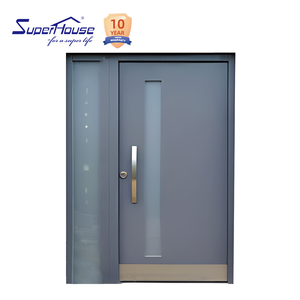
Luxury Aluminum Hurricane Impact Front Entry Door NOA FPA AAMA NFRC Certified High Wind Resistant Villa Exterior Hinged Door
Get a Quote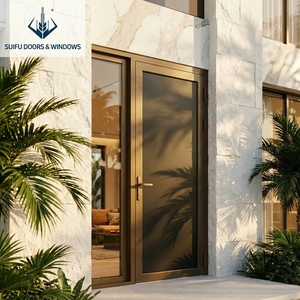
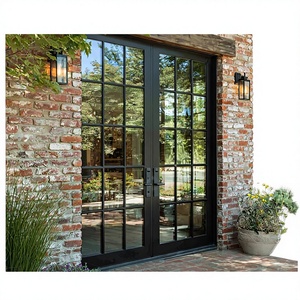
French Style Aluminum Alloy Swing Front Entry Door AS2047 Double Glazed Hurricane Proof Entrance Door
Get a Quote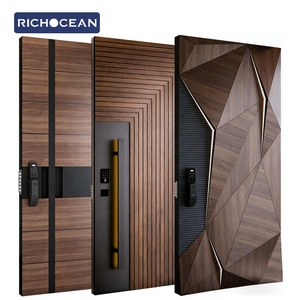
Richocean Luxury Bulletproof lamborghini Front Entry Door Aluminum Storm Security Voordeur Residential Doors
Get a Quote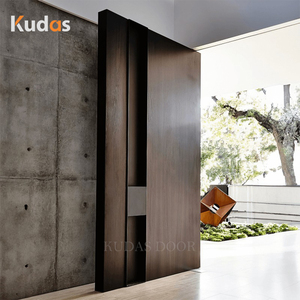
Main Entrance Exterior Walnut Solid Wood Large Front Door Single Aluminum Modern Front Entry Wooden Pivot Door
Get a Quote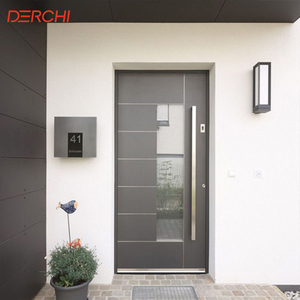
Exterior Aluminum Entry Door Front Door Security Door for Homes Villas and Apartments Custom Size
Get a Quote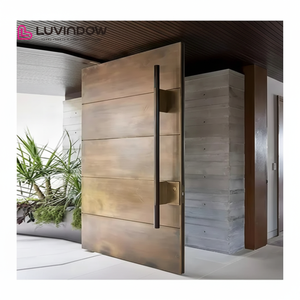
American Style Contemporary Solid Wood Entry Main Entrance Wooden Doors Front Doors for Houses Modern Exterior Main Pivot Door
Get a Quote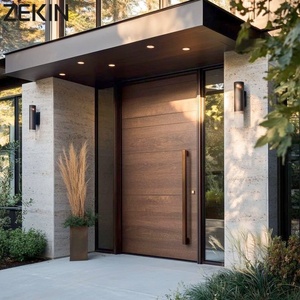
ZEKIN Modern American Design House Heat Insulation Fire Prevention Luxury Entrance Pivot Door House Front Entry Doors
Get a Quote1997.
Established Year (Nearly 30 yrs engineering)
160,000m²
Dongying Smart Manufacturing Base
219+
Patented Fenestration Technologies
CE / AS2047
Global Regulatory Compliance Tested
Executive Summary: The Technical Evolution of CE Certified Aluminum Entry Doors
In contemporary architectural engineering, the exterior main entrance serves as both a primary aesthetic statement and the most critical barrier for building envelope performance. As global building energy codes tighten—mandated by directives such as the European Union’s Energy Performance of Buildings Directive (EPBD) and North America's ASHRAE 90.1 standards—the procurement criteria for entry doors have shifted dramatically. Simple aesthetic appeal is no longer sufficient; commercial buyers, façade engineers, and property developers now require rigorous structural verification, verified U-values below 1.0 W/m²K, and certified compliance under international frameworks.
Selecting a certified manufacturer of CE Certified Modern Aluminum Entry Doors requires a deep technical understanding of thermal break technology, extrusion metallurgy, hardware load capacities, and multi-point sealing dynamics. Non-thermal break aluminum frames act as thermal bridges, resulting in severe interior condensation, structural expansion stress, and thermal energy loss. Leading Chinese original equipment manufacturers (OEMs), such as Crestor Door Manufacturing Co., Ltd., have solved these historical vulnerabilities through advanced PA66 polyamide thermal breaks, CNC precision machining (controlled to ±0.05 mm), and integrated laser cold-welding corner assembly.
Key Engineering Takeaway: A true CE-marked modern aluminum entry door under EN 14351-1 must provide verifiable third-party test data verifying air permeability (EN 12207 Class 4), water tightness (EN 12208 Class 9A or higher), wind load resistance (EN 12210 Class C5), and acoustic insulation (Rw ≥ 42 dB).
Material & Performance Specification Matrix for Global Importers
When issuing a Bill of Quantities (BOQ) or tender package for high-end residential villas or commercial developments, project engineers must mandate strict material specifications. The table below outlines the industrial baseline for export-grade aluminum entrance doors vs. commercial grade alternatives:
| Performance Parameter | Standard Export Grade | Crestor OEM Architectural Grade | Testing Standard / Certification |
|---|---|---|---|
| Aluminum Alloy Profile | 6063-T5 (Wall thickness 1.4 - 1.8mm) | 6063-T6 / 6060-T66 High Precision Extrusion (2.0 - 3.0mm) | GB/T 5237 / ASTM B221 |
| Thermal Insulation Strip | PVC / Low-grade Nylon (14.8mm) | Technoform Polyamide PA66-GF25 (24mm - 34mm multi-chamber) | EN 14024 Compliance |
| Glazing Specification | 5mm + 12A + 5mm Double Clear Tempered | 6mm Low-E + 16Ar (Argon) + 6mm Laminated Smart Glazing | EN 12150 / AS/NZS 2208 |
| Wind Pressure Load | 3.0 kPa (Grade 6) | 5.0 kPa (Grade 9 / Top Class structural integrity) | GB/T 31433 / EN 12210 Class C5 |
| Water Tightness | 350 Pa (Grade 4) | 700 Pa (Grade 6 / Hurricane wind-driven rain proof) | EN 12208 Class E750 / AAMA 501 |
| Acoustic Isolation | Rw = 32 dB | Rw = 42 – 45 dB (Multi-chamber EPDM triple seal) | ISO 10140-2 / EN 717-1 |
| Surface Finish Quality | Standard Powder Coating (60 µm) | AkzoNobel Interpon / PVDF Fluorocarbon (80-100 µm, 25-yr warranty) | AAMA 2605 / Qualicoat Class 2 |
Industry Forecast
Future Sourcing & Architectural Trends in Aluminum Entry Doors
Analysis of structural mechanics, hardware automation, and energy-efficiency standards shaping global B2B procurement over the next decade.
Oversized Pivot & Heavy-Load Engineering
Modern architecture favors grand entrances exceeding 1.8 meters in width and 3.5 meters in height. Future procurement is pivoting toward continuous offset pivot hinges capable of carrying leaf weights up to 500 kg with zero frame sag or latitudinal distortion over decades of operational cycles.
Smart Access & Biometric Integration
Mechanical keyways are rapidly being replaced by fully integrated, concealed smart locks. B2B buyers now mandate factories to pre-wire profiles for 3D facial recognition, biometric fingerprint sensors, motorized multi-point bolt lock actuators, and smart home IoT automation protocols (Zigbee/Matter).
Passive House Thermal Performance
Driven by net-zero building directives, entrance doors must achieve U-factors below 0.8 W/m²K. Future demand heavily favors vacuum insulated glass (VIG), quad-glazed argon fill, and aero-gel infused multi-chamber polyamide thermal barriers embedded within the core extrusion frames.
Severe Weather & Impact Resilience
Coastal developments in Florida, Australia, the Caribbean, and Southeast Asia increasingly require High Velocity Hurricane Zone (HVHZ) certifications. Sourcing guidelines mandate Florida Notice of Acceptance (NOA) and Australian AS2047 hurricane impact ratings with SentryGlas® (SG) interlayer laminated glass.
Laser Cold-Welded Corner Seamless Aesthetics
Traditional mechanical corner crimping often leads to visible joint lines and sealant degradation over time. Advanced manufacturers are transitioning to automated laser cold-welding, creating seamless frame corners that enhance torsional rigidity by 40% and eliminate water ingress at frame joints.
Digital Twin & BIM Procurement Workflows
Leading architectural firms require BIM (Building Information Modeling) objects for every door assembly prior to order placement. Modern entry door manufacturers must supply full Revit LOD 350 models, enabling precise clash detection, thermal envelope simulation, and automated structural load verification.
Enterprise Advantage: Crestor Door Manufacturing Co., Ltd.
Founded in 1997, Crestor Door Manufacturing Co., Ltd. has spent nearly three decades perfecting thermal break aluminum window and door systems. Operating from our Beijing R&D headquarters and a state-of-the-art 100,000 m² smart manufacturing base in Dongying, Shandong, Crestor represents the apex of factory-direct OEM/ODM production. Unlike trading companies or regional fabricators who outsource basic components, Crestor owns and controls the entire vertical manufacturing chain: profile machining, powder coating, insulating glass processing (IGU), and final system assembly.
With over 200 engineers, technicians, and specialized craftsmen, Crestor holds more than 219 patented fenestration technologies. Our structural systems undergo stringent destructive testing at national window test laboratories, delivering verified performance including 5.0 kPa wind load resistance (GB/T 31433 Grade 9), 700 Pa water tightness, and sound insulation up to Rw 44 dB.
CNC Precision Machining
Profile cutting and hardware routing executed by 5-axis German CNC equipment accurate to ±0.05 mm, ensuring air-tight joinery and effortless lock engagement.
Full Quality Certification
Certified to ISO 9001:2015, holding AS 2047 StandardsMark™ Licence SMK41686, CE EN 14351-1 conformity, and configured for NFRC target markets globally.
End-to-End Export Logistics
Heavy-duty export packaging including custom wooden crates, rubber corner protectors, and moisture-proof vacuum wrapping to guarantee zero damage during sea transit.
Sourcing Guide
Frequently Asked Sourcing & Technical Questions
Clear, engineering-backed answers addressing compliance, customization, lead times, and structural options for global B2B procurement directors.
What technical documentation is required to verify CE certification for aluminum entry doors?
To satisfy European Union building authorities under EN 14351-1, a manufacturer must provide a formal Declaration of Performance (DoP), initial type testing (ITT) reports from an accredited notified body, and proof of Factory Production Control (FPC) certification under ISO 9001. Crestor provides full test certification detailing thermal transmittance (U-value), air tightness, water permeability, and structural wind resistance for seamless customs clearance and site inspection approval.
What is the structural difference between single-hinged doors and pivot entry doors?
Standard hinged doors pivot along side-mounted butt hinges, placing all rotational strain on the vertical side jamb—limiting maximum leaf width to approximately 1.1 meters and weight to 150 kg. In contrast, heavy-duty aluminum pivot doors rotate on top and bottom floor-mounted pivot spindles set back from the frame. This architecture transfers 100% of the door's vertical load directly into the structural floor slab, allowing leaf widths up to 2.2 meters, heights up to 4.5 meters, and total panel weights exceeding 500 kg without frame sagging.
How does a PA66 polyamide thermal break prevent frame sweating and thermal bridging?
Aluminum is a natural conductor of thermal energy. Without a thermal break, cold exterior temperatures rapidly transfer through the aluminum extrusion to the interior surface, causing heat loss and moisture condensation ("frame sweating"). A PA66-GF25 thermal break consists of glass-fiber reinforced polyamide strips mechanically crimped between the interior and exterior aluminum extrusions. This creates an isolated thermal barrier with extremely low thermal conductivity (approx. 0.3 W/mK compared to raw aluminum’s 160 W/mK), maintaining interior frame temperatures well above dew point.
What documentation is required to start a custom OEM/ODM production order?
To initiate a custom order, buyers can supply architectural elevation drawings, a CAD/BIM model, a project Bill of Quantities (BOQ), or rough opening dimensions. Crestor's engineering team conducts structural load calculations, selects profile depth and glazing configurations, and issues detailed 2D/3D shop drawings for client sign-off. Production begins only after the client approves the shop drawings and corner/material samples.
Can Crestor supply hurricane-impact certified entrance doors for severe storm zones?
Yes. Crestor manufactures specialized hurricane-impact entrance systems engineered to meet Florida Building Code (NOA), AAMA 501, and Australian AS2047 requirements. These systems feature heavy-wall 3.0mm structural aluminum extrusions, multi-point lock hardware, and double or triple laminated safety glass incorporating SentryGlas® (Kuraray) interlayers capable of withstanding missile impact testing and wind-driven water pressures up to 700 Pa.
What is the standard lead time and container packaging method for international shipping?
Standard lead time for custom aluminum entry door production is 25 to 35 days following shop drawing sign-off and sample approval. For ocean export, every door unit is wrapped in protective PE anti-scratch film, fitted with heavy-duty rubber corner guards, sealed in moisture-barrier wrap, and packed inside fully enclosed steel-strapped plywood crates. Containers are loaded using automated forklift ramps and floor-anchored webbing to prevent movement during sea freight.
Ready to Source Certified Aluminum Entry Doors for Your Next Project?
Work directly with Crestor's fenestration engineering team. Send your architectural drawings, opening schedules, or BOQ for immediate profile selection, CAD shop drawings, and competitive factory-direct pricing.